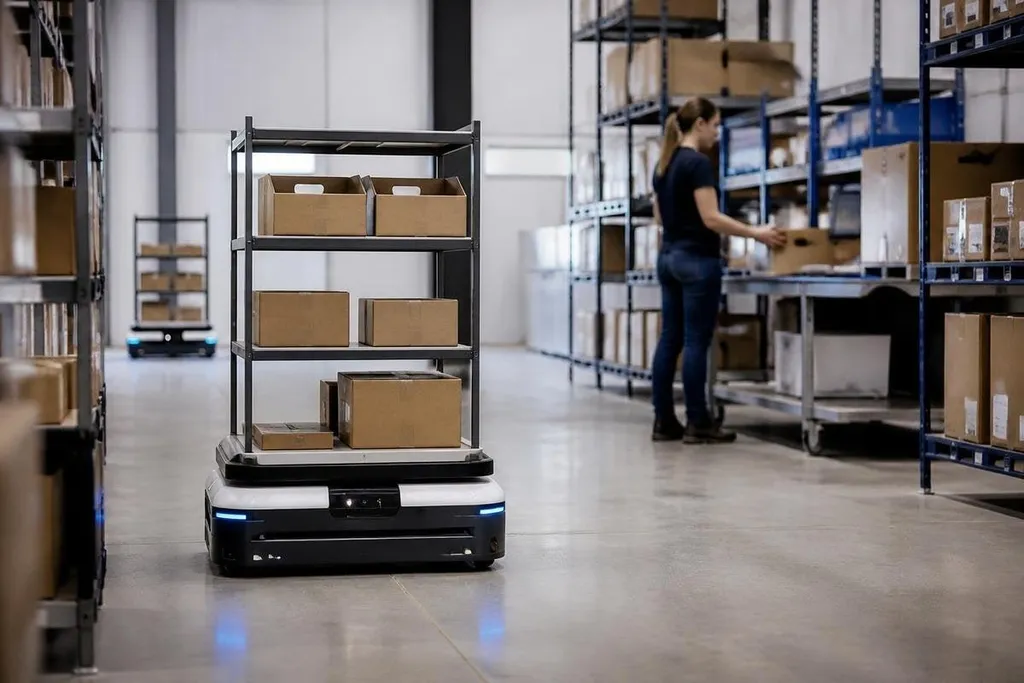
A warehouse robot can move goods, pick items, or carry stock between work areas. The larger business opportunity sits around that robot: planning, installation, software, service, training, and safety.
Quick read
- Robot makers need partners that can install and maintain machines
- Software can connect robots to warehouse orders and worker tasks
- Small warehouses may buy services before they buy a full robot fleet
Where the money is
Robot sales are the most visible part of warehouse automation. An autonomous mobile robot, or AMR, can carry shelves or bins through a facility without a driver.
A robotic arm can pick or place goods from a fixed station. Each machine creates work for companies that prepare the site and keep the system running.
Installation is one opening. A warehouse may need changes to floor markings, charging points, network access, safety zones, and storage layouts. A firm that can survey the site, set up the equipment, and test the handoffs can sell a project without making the robot itself.
Integration is another. Warehouse software holds orders, stock data, and worker tasks. Robot control software must receive the right job and report the result. An integrator can connect those systems, set rules for traffic, and give managers a clear view of failed jobs or blocked routes.
That work matters because a robot working alone has limited business value. The system has to fit the warehouse process around it.
Software creates repeat income
Hardware sales usually happen at the start of a project. Software can bring in income as the warehouse adds robots, changes its layout, or connects new order systems.
Useful software may assign jobs, plan routes, manage charging, track robot health, or send alerts when a task stops. It may also show where workers and robots wait for one another. Those functions give operators a way to find delays without watching each machine by hand.
A software company can sell a control layer that works with more than one robot model. That approach gives warehouses more choice, though it also creates a hard technical job: each robot maker may use different interfaces, safety rules, and data formats.
A company selling software around warehouse robots needs to know which machines run which tasks and where operators still step in. A report from Robot24 can add named systems, work sites, and dates to that review. Those facts help a buyer judge whether the business should sell software alone or take on the service work too.
Service may matter more than the sale
Warehouse robots run near shelves, pallets, people, and loading equipment. Wheels wear down. Cameras collect dust. Batteries lose capacity. A service company can inspect machines, replace parts, clean sensors, and check safety functions on a planned schedule.
Remote support can add another layer. A technician may review logs before visiting a site, which can help identify a failed sensor or blocked route. The service still needs a clear limit: remote checks cannot replace physical inspection when a machine has been damaged.
Training is also a business. Staff need to know how to clear a stopped robot, use an emergency stop, report a damaged shelf, and restart a task safely. Managers need records that show who received training and which checks were completed.
Smaller customers need a different offer
A large distribution center may buy a full automation project. A smaller warehouse may need help with one repeated task, such as moving bins between storage and packing.
That creates room for rental, leasing, managed service, and short-term project models. The customer pays for robot access or completed work instead of buying every machine at the start. The provider then carries more responsibility for uptime, repair, and replacement.
The risk sits in the contract. A service price must account for travel, spare parts, charging time, software fees, and work that still needs people. A low monthly price can become a bad deal if the provider has priced only the robot and ignored the rest.
I’d start with one narrow task and a clear measure, such as completed moves per shift or reduced travel for workers. A broad promise about automating the warehouse is too hard to price and too easy to dispute.
A practical business checklist
Before building a warehouse robotics service, check these points:
- Pick one task where the robot’s work can be counted
- Name the warehouse software the service must connect to
- Price installation, training, repairs, travel, and spare parts
- Set a response time for stopped or damaged machines
- Define which jobs stay with people
- Test the service in one work area before adding more sites
The strongest business may be the one that removes work around the robot rather than selling another robot. A company that can make deployment, daily use, and repair easier has a clear job to price, measure, and improve.